
Why puzzles matter for architecture learning
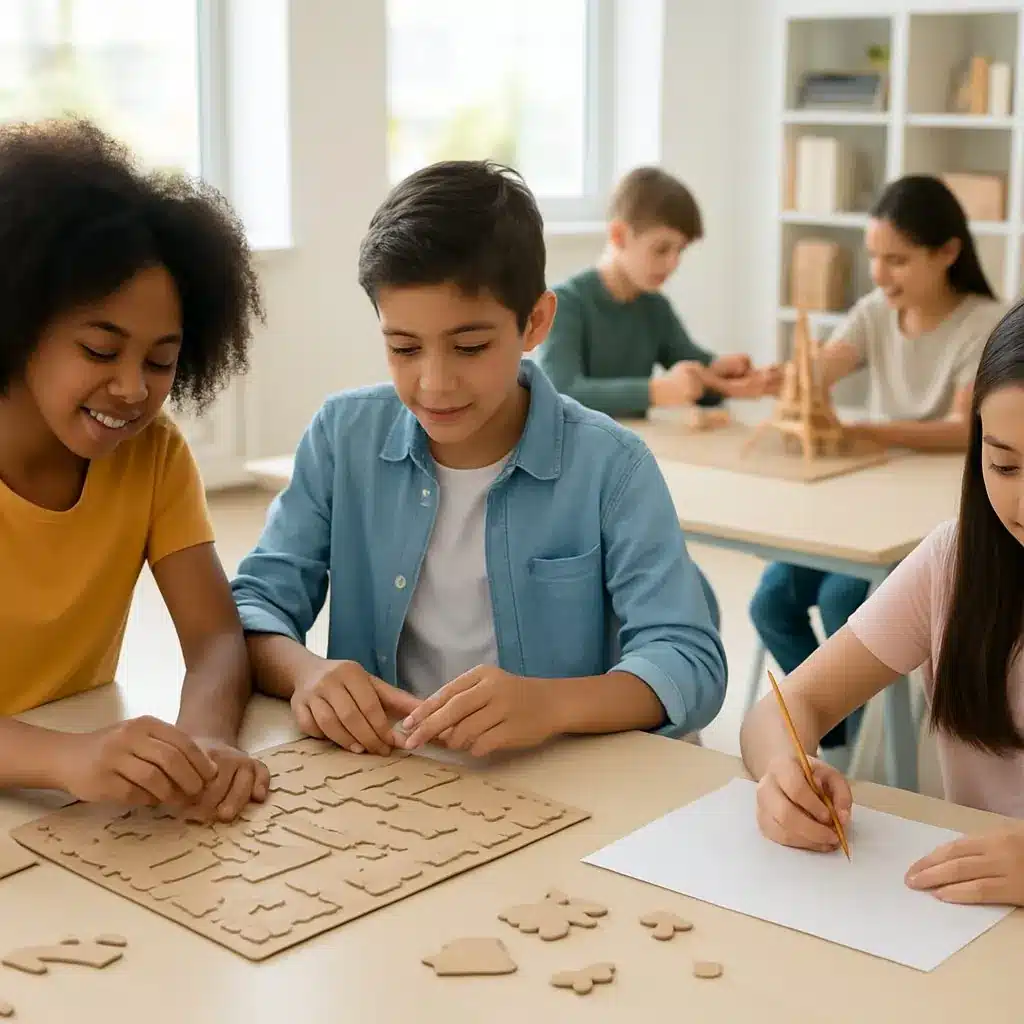
Puzzles—whether traditional jigsaws, tangram sets, or 3D landmark models—offer concrete practice with spatial relations, visual problem solving, and iterative design. Research in cognitive psychology points to the role of spatial skills (mental rotation, spatial visualization, and spatial working memory) in fields like architecture, engineering, and the visual arts. In classroom settings, puzzles provide an accessible entry point for these skills while connecting students to form, proportion, sequence, and material constraints.
Core skills supported by puzzle-based activities
- Mental rotation: Turning parts or pieces in the mind to match a target orientation—useful for interpreting plans and 3D forms.
- Spatial visualization: Imagining how separate elements combine into a whole, key to composing a façade or detailing a structural connection.
- Proportional reasoning: Understanding scale relationships between elements and translating between model scale and real-world dimensions.
- Sequential problem solving: Planning assembly steps and anticipating constraints, a direct match to design process thinking.
- Material and construction awareness: Gained by handling pieces, choosing adhesives or connectors, and testing stability in 3D assemblies.
Evidence-informed perspective
Controlled studies indicate that targeted spatial training—using block-building, puzzles, and visualization tasks—can improve specific spatial skills. Those gains often transfer to related tasks such as map reading, interpreting plans, or solving geometry problems, especially when practice is sustained and varied. That said, transfer is not automatic: effective classroom activities blend hands-on puzzle practice with explicit reflection, sketching, and vocabulary that ties the activity to architectural concepts.
Design thinking through guided puzzle work
Puzzles naturally scaffold design thinking because they require iterative testing, evaluation, and refinement. Teachers can amplify this by prompting students to:
- Define the problem (what is the intended form or function?).
- Generate multiple assembly strategies (try different orders or orientations).
- Prototype rapidly (use cardboard mock-ups, foam core, or low-cost 3D prints).
- Reflect and document (sketch steps, note failures and fixes).
Classroom activity ideas
Each activity below is adaptable for middle school through introductory college-level design courses. Learning objectives and differentiation notes follow each description.
1. Skyline jigsaw: scale and proportion (45–60 minutes)
Give small teams a jigsaw or printed silhouette set representing a city skyline. Ask students to assemble at scale on a 1:500 base, then sketch the resulting massing and annotate heights and famous features. Follow with a short critique where teams explain how proportion influenced legibility.
- Objectives: proportional reasoning, massing recognition, oral presentation.
- Differentiation: pre-cut pieces for younger students; open-ended skyline for advanced students to design additions.
2. 3D landmark assembly and reverse engineering (multi-session)
Use a 3D puzzle of a landmark (or a simple laser-cut kit). Students document the assembly order, then create a short instruction sheet that teaches someone else to assemble the model. Finish with a brief redesign task: modify one structural element to improve stability or reduce material.
- Objectives: sequence planning, technical writing, structural thinking.
- Differentiation: scaffolded templates for younger students; CAD export and iteration for older students.
3. Tangram challenge: abstract form to function (20–40 minutes)
Provide tangram pieces and prompts like “create a façade with a central entrance” or “compose a pavilion in plan.” Have students rotate and compose pieces, then sketch the elevation and label primary axes and symmetries.
- Objectives: symmetry, axis recognition, translating between 2D and 3D thinking.
- Differentiation: timed challenges for fast-paced classes; open studio time for deeper exploration.
Linking history and meaning
To deepen design intent, pair puzzle activities with short historical readings or image studies. For instance, use a model of a particular building as a prompt to discuss cultural context, material choices, and stylistic features. This integrates formal skills with narrative and interpretation—encouraging students to ask not only “How does this fit?” but “Why was it built this way?” For guidance on weaving historical context into lessons, see design history and cultural context.
Designing puzzles for learning
If you create or commission puzzles for your class, consider intentional constraints: limit the number of similar pieces, vary connector types, or design ambiguous pieces that require verbal negotiation. These choices shape the learning: clarity supports early success and confidence, while ambiguity promotes discussion and strategic planning. Practical tips and production considerations are collected in our guide to design tips for educational puzzles.
Assessment and reflection
Assessment should combine product and process. Use simple rubrics that value:
- Accuracy of assembly or model (product).
- Justification of decisions—sketches, annotations, and written reflections (process).
- Peer feedback quality during critiques (collaboration).
Rubrics might weight reflection and reasoning more heavily than a perfect assembly to encourage experimentation.
Resources and examples
To put activities into practice quickly, gather a small kit: tangrams, low-cost 3D model kits, modular blocks, and simple laser-cut or cardboard templates. For ready-to-use project visuals and classroom-tested models, consult our curated project examples to use in class. These examples demonstrate how scale, assembly complexity, and historical context can be combined into short lessons or multi-week projects.
Final notes for educators
Puzzles are a flexible, low-barrier tool for developing spatial reasoning and introducing students to basic design thinking. The most effective lessons pair hands-on construction with explicit vocabulary, sketching, historical context, and reflective critique. With modest materials and thoughtful prompts, teachers can help learners build the spatial habits of mind that underpin architecture and design.