
Why architectural imagery needs a tailored approach
Design architecture jigsaw puzzles that are both beautiful and solvable by treating the building as more than a picture: it is a set of planes, rhythms, textures, and spatial relationships. The same visual clarity that makes a façade legible can make a puzzle either engaging or frustrating. This guide offers practical, repeatable choices designers and makers can use to turn architectural photographs, elevations, and illustrations into satisfying puzzles for a range of players.
Start with composition and contrast
Good composition is the foundation of a readable puzzle. For architectural motifs, prioritize elements that create natural segmentation — towers, cornices, window grids, parapets, and shadow bands.
- Choose a focal hierarchy: Decide what will be the visual anchors (main entrance, dome, spire). Place them off-center or on thirds to create natural clusters of pieces.
- Maximize tonal contrast: Higher contrast between adjacent surfaces helps solvers distinguish edges. If your source photo is flat, consider light retouching or adding subtle vignettes to boost readability.
- Preserve architectural rhythms: Windows and repetitive details are excellent for mid-difficulty puzzles because repetition creates pattern recognition tasks. For beginner puzzles, pick images with distinct zones (sky, façade, foreground).
Work with the image, don’t against it
Avoid cropping that cuts important architectural lines at awkward points; instead crop to emphasize horizontal or vertical order depending on the building. For example, a strong vertical spire benefits from tall, narrow formats, while a row of terraces reads well in wide panoramas.
Piece-cut strategies for facades and skylines
Piece shape and cut pattern are where design meets play. Architectural puzzles reward thoughtful variation in piece shapes tied to the image content.
Facade-focused puzzles
- Align cuts with architectural lines: Use die cuts that echo strong mullions or cornices; long straight-piece runs along these lines increase the satisfaction of assembling continuous features.
- Break up repetitive grids: For window grids, intentionally introduce a few irregular or distinctive pieces (a corner with a balcony, a different-colored window) so solvers have anchor pieces within repetitive fields.
- Create texture zones: Group stone, brick, glass into separate piece clusters by varying cut density. Denser cuts in detailed areas and larger pieces in flat areas balance challenge and progress.
Skyline and panorama puzzles
- Use negative space as a tool: Sky and water are intentionally more uniform — use larger, simpler pieces there to avoid tedium.
- Silhouette anchors: Make skyline outlines composed of medium complexity pieces. The silhouette provides an immediate frame for solving the inner details.
- Consider progressive difficulty: For wide panoramas, design zone transitions so solvers can tackle left-to-right or top-to-bottom segments. Keep horizon lines continuous to aid orientation.
Scale and difficulty: mapping piece count to image anatomy
Decide your target audience first. A 300–500 piece puzzle suits hobbyists who want a distinct challenge without commitment; 1,000+ pieces is for experienced solvers. But piece count alone doesn’t determine difficulty — piece distribution, image complexity, and cut strategy matter more.
Rules of thumb
- Beginner (100–300 pieces): Use high-contrast images with clear zones and larger piece sizes. Keep the sky and flat surfaces simple.
- Intermediate (300–800 pieces): Introduce repeating patterns (window grids, brickwork) with a mix of distinctive anchor pieces.
- Advanced (800+ pieces): Use detailed facades, night scenes with subtle tonal shifts, or long panoramas where orientation is less obvious.
Designing packaging and assembly instructions
Packaging is part of the puzzle experience. Clear box art, a helpful reference guide sheet, and suggested assembly strategies make a product accessible and confers a sense of design intent.
- Box front: Use the original image with a small inset showing scale, piece count, and a close-up detail to highlight texture.
- Back of the box / inside leaflet: Include a labeled diagram pointing out architectural features to look for (e.g., “look for the triangular pediment above the central doorway”). This is also a place to add a short design note about the building’s style or era to enhance the user’s connection to the subject.
- Assembly tips: Recommend sorting strategies tailored to the image — edge-first for classical facades, silhouette-first for skylines, or grouping by material (glass vs. stone) for modernist subjects.
Workflow: from photo to die line to prototype
- Source and prepare the image: Verify licensing and color-correct for clarity. Consider two versions: a higher-contrast edit for smaller-piece puzzles and a faithful edit for larger-piece or collector editions.
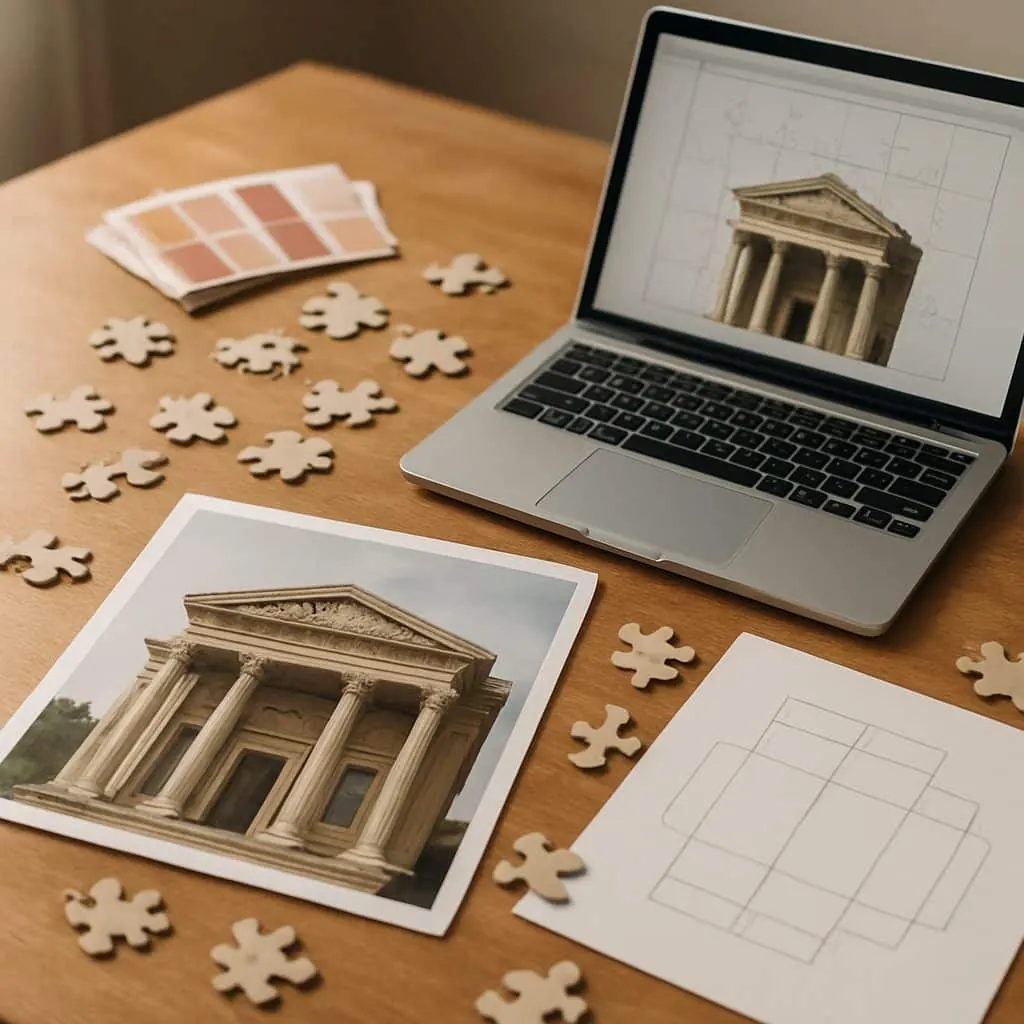
- Create a die-line map: Design your cut paths to interact meaningfully with architectural lines. Sketch several variants—regular grid, organic shapes, and hybrid patterns—and test readability on screen at intended print size.
- Prototype and playtest: Produce a short-run prototype using local print facilities or print-on-demand. Assemble and invite external testers of different skill levels. Watch for choke points — repetitive areas that stall progress — and adjust cuts or image edits accordingly.
- Materials and finishing: Design decisions depend on available materials and printing techniques; for details on substrates, board thickness, and printing methods consult materials and printing options.
Expand beyond flat puzzles
Architectural puzzles naturally bridge to other maker projects. If you’re interested in translating a 2D puzzle design into a physical landmark kit or combining a puzzle with a removable 3D element, see resources on building 3D landmark models for methods that reuse the same visual assets and design logic.
Use cognitive principles to enhance learning and challenge
Think about how people perceive space. You can design puzzles that teach or test spatial skills by intentionally manipulating visual cues such as depth, overlap, and scale. For a deeper look at these concepts and how they inform puzzle design, consult spatial reasoning and design thinking.
Final considerations and checklist
Before going to production, run through this checklist:
- Does the composition provide clear anchors and varied zones?
- Are piece cuts designed to reinforce architectural lines and avoid redundant repetition?
- Is the intended difficulty level consistent with piece count and cut density?
- Have you prototyped and playtested with representative solvers?
- Are packaging and instructions written to guide the solver’s first strategy?
Designing architecture-themed jigsaw puzzles is an exercise in respecting built form while shaping a playable experience. With deliberate composition, cut strategies that echo architectural logic, and thoughtful testing, you can turn a photo of a building into a puzzle that is both a collectible and a satisfying exercise in spatial reasoning.