
Introduction
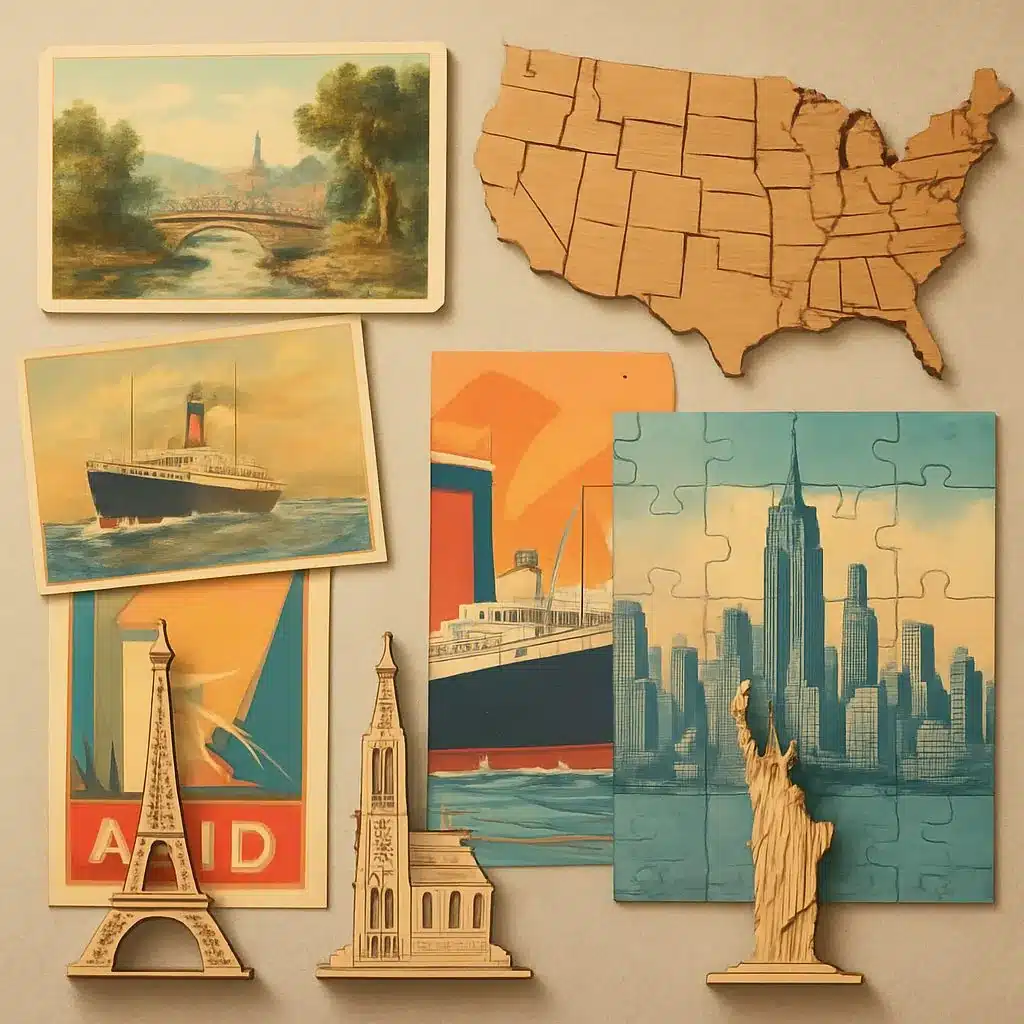
Buildings and monuments have long served as more than shelter or civic statement: they are visual shorthand for place, values, and memory. That shorthand has migrated from paintings and postcards into the world of puzzles and models, where designers reduce facades, curves, and skylines into pieces that can be assembled, held and reenacted. This article traces how famous buildings entered popular culture through souvenirs, educational tools and mass-market entertainments, and how successive design movements affected the way structures are represented in printed and assembled media.
From souvenirs and teaching tools to mass-market puzzles
The relationship between buildings and small-scale objects dates back centuries. Early engraved views, travel prints and guidebooks put architecture into portable form; travelers collected these images the same way they collected lockets or coins. In the late 18th and 19th centuries, craftsmen and educators began to translate maps and views into interactive formats—cut-out atlases and wood-mounted map puzzles created for teaching geography are an early example of architecture being used as a practical learning tool.
By the late 19th and early 20th centuries, advances in printing (notably chromolithography) and mass production made illustrated souvenirs widely affordable. Postcards, souvenir tins and printed puzzles that featured famous monuments and cityscapes became staples of tourism economies. World’s Fairs and international expositions played a catalytic role: they circulated iconic images of new engineering feats and stylistic innovations, and those images were rapidly reproduced in puzzles, posters and toys for a growing consumer audience.
How design movements simplified—and stylized—structures
Each major design movement left a clear imprint on how buildings were represented in popular media:
- Victorian realism: early souvenir images emphasized detail and ornament, reflecting contemporary taste for accurate, picturesque depiction.
- Art Deco and Modernism: with their emphasis on geometry, contrast and bold silhouettes, these movements encouraged graphic reduction. Facades and towers were translated into clean shapes—ideal for high-contrast prints and puzzle art that relied on large, easily recognizable areas of color.
- Mid-century graphic design: poster art and commercial illustration favored flat colors and simplified perspectives, a look that translated well into flat jigsaw puzzles and educational flashcards.
- Contemporary minimalism and abstraction: recent designers have pushed further toward iconography—reducing a complex building to one or two defining elements (a spire, a dome, a particular window pattern) so that a silhouette alone signals identity.
These stylistic shifts didn’t just reflect aesthetic trends; they solved practical problems. A simplified depiction reads more clearly when printed on textured board, when cut into interlocking pieces, or when reduced to a small 3D kit. Reducing a building to its archetypal lines makes it easier for puzzle makers to balance recognizability with manufacturability.
Puzzles as cultural shorthand and civic iconography
Part of the power of architectural puzzles is their reliance on the viewer’s ability to recognize a place from a fragment: a curve of a dome, a stepped roofline, a distinctive tower. Over time, designers learned to exploit silhouette and negative space as the densest carriers of meaning. That same process—the reduction of a complex place to a memorable outline—explains why posters, logos and puzzles often use the same visual cues to signal city identity.
For a deeper look at how skylines and silhouettes became shorthand for place in popular media and puzzles, see the role of skylines in cultural identity. For examples of how contemporary designers continue to reinterpret landmarks in puzzle form, consult examples of how designers interpret landmarks, which illustrates the range from literal miniatures to graphic silhouettes and negative-space challenges.
Educational value and cognitive design
Architectural puzzles are more than nostalgic souvenirs; they are tools that scaffold spatial thinking. Reducing a building to pieces asks the player to understand relationships between planes, volumes and ornament—skills that translate into visual literacy and design awareness. This educational aspect connects historical uses of architectural images in classrooms to contemporary interest in puzzles as cognitive tools; for more on this linkage, see educational value of puzzle-based learning.
Designing and manufacturing constraints that shaped style
Practical manufacturing realities nudged designers toward particular visual languages. A few recurring constraints:
- Material and print resolution: early chromolithographs and pressboard limited the amount of tiny detail that could reproduce clearly.
- Piece shape and negative space: puzzles need interlocking pieces; designers often balanced ornate ornament with broad color areas to keep pieces distinguishable.
- Scale and recognizability: miniature 3D kits required emphasizing the most defining features of a structure to preserve identity at a small scale.
As technology changed—laser cutting, CNC milling, high-resolution digital printing—the constraints loosened. Makers can now render complex facades in wood or acrylic and experiment with non-rectilinear piece shapes, which has encouraged a split market: faithful scale models for collectors, and abstracted graphic puzzles for broad audiences.
Practical takeaways for makers, designers and collectors
- When translating a building into a puzzle, identify the few features that make it instantly recognizable (roofline, tower, window rhythm) and prioritize them in the design.
- Consider material early: cardboard favors high-contrast graphics; wood supports tactile, sculptural kits.
- Decide whether you want realism or symbolism: both serve different audiences—collectors often prefer scale and detail, while souvenir and educational markets respond to simplified, iconic art.
Conclusion
Famous buildings have moved from being landmarks in the skyline to landmarks in popular culture through an evolving language of representation. From hand-cut teaching maps to glossy chromolithographs, from Art Deco posters to laser-cut 3D kits, each technological and stylistic development changed how architects and designers distilled complexity into a playable, collectible object. That distillation shapes our public imagination: a single spire, a dome or a skyline silhouette can stand for a city, a moment in design history, or a set of civic ideals—and a puzzle is often the place where that meaning is rehearsed, learned and cherished.