
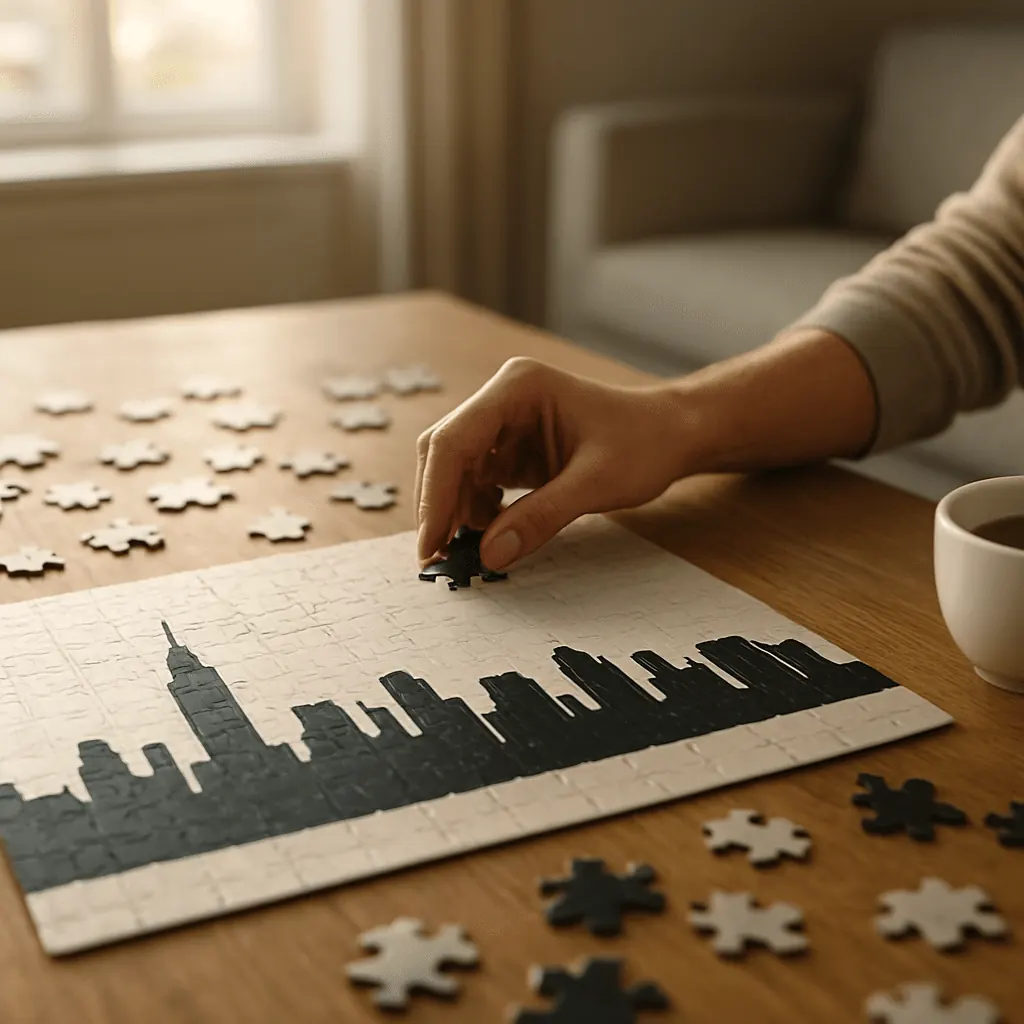
Skyline jigsaw puzzles—images of city horizons, famous skylines, and iconic building silhouettes—pack dense visual information into a playful format. For players and students of architecture, they offer more than entertainment: they create a repeatable practice for parsing rhythm in the built environment and for recognizing landmarks by form, proportion, and context.
What architects and designers mean by “visual rhythm”
Visual rhythm refers to the pattern and pace created by repeated elements in a composition—columns, windows, rooftops, spires, and gaps between buildings. In urban design, rhythm emerges from the alternation of mass and void, uniformity and variation. It helps a viewer anticipate and navigate space; when rhythm is clear, a skyline reads coherently even at a glance.
Skyline puzzles make rhythm tangible. A player sorting pieces quickly begins to detect repeating window patterns, alignments of cornices, or a rise-and-fall profile of roofs. That mental grouping of repeated features is the essence of visual rhythm training.
Why skylines are ideal for teaching landmark recognition
Landmark recognition relies on identifying features that are visually distinctive and contextually meaningful. In a skyline these features often appear as silhouettes—sharp spires, dome profiles, or uniquely shaped towers—and as relational clues, like a cluster of low-rise buildings next to a single tall spire.
Jigsaw puzzles of skylines strip away motion, sound, and human scale and reduce a city to outlines, color blocks, and spatial relationships. That simplification focuses attention on the cues that actually define landmarks: proportion, edge geometry, and relative position. Over repeated exposure, players start to identify landmarks by partial information: a fragment of a dome or a particular window rhythm can trigger recognition.
Gestalt principles at play
- Similarity: Repeating shapes (rows of windows, regular balconies) are grouped together mentally.
- Proximity: Pieces with nearby features are tested together to form coherent building masses.
- Closure: Even when only a fragment is visible, the brain completes missing contours to form a recognizable silhouette.
How assembling a skyline puzzle trains these skills
Working a skyline puzzle enforces a series of perceptual habits that map directly to visual rhythm and landmark recognition:
- Edge and silhouette-first building: Players often begin by laying out the skyline’s horizon line—the silhouette where sky meets buildings. This isolates the primary rhythm and creates a scaffold for the rest of the image.
- Grouping by repeated modules: Windows, spires, and roof tiles recur across pieces; sorting pieces by these modules helps players mentally organize the skyline’s rhythm.
- Negative-space reading: Gaps between buildings or sky shapes between spires become as informative as the buildings themselves, teaching players to process voids as structural cues.
- Scale inference from partial cues: A single tall window or a narrow tower fragment cues the likely scale and position of a landmark, guiding where a piece should fit.
Practical exercises for educators and enthusiasts
These short activities can be used in a design studio, classroom, or puzzle club to make the perceptual lessons explicit.
- Silhouette sketching: After completing a skyline puzzle, have students trace the skyline silhouette freehand. Discuss which shapes were most informative and why.
- Partial reveal challenge: Cover a completed puzzle and reveal only small fragments. Ask players to identify the landmark or section using minimal information.
- Group rhythm mapping: Divide the skyline into vertical strips and ask groups to mark repeating motifs (windows, ledges, spires) and label the rhythm types—regular, alternating, or irregular.
- Reverse-design exercise: Give students a skyline silhouette and ask them to design a façade detail that would be instantly recognizable when reduced to a puzzle piece.
Tips for puzzle designers who want to emphasize rhythm and recognition
Design choices influence what cognitive skills a puzzle trains. For designers of architectural or skyline jigsaws:
- Choose clear silhouettes: High-contrast outlines make landmark silhouettes legible when reduced to pieces.
- Balance repetition and uniqueness: Too much uniformity makes sorting tedious; too many unique features removes rhythm. Aim for repeated modules punctuated by a few distinctive landmarks.
- Use color to separate masses: Subtle color blocks can help players group neighborhoods or building types without flattening the challenge.
- Consider piece shape as a cue: Nonstandard piece shapes that echo architectural forms (arched piece tabs, rectangular modules) can provide tactile clues that reinforce visual recognition.
Who benefits and how this transfers to professional skills
Beyond hobbyists, architecture students, urban designers, and heritage interpreters can gain practical perceptual training from skyline puzzles. The habits developed—fast silhouette reading, grouping by module, and negative-space analysis—translate into better sketching speed, improved site analysis, and a keener eye for compositional balance in façades and streetscapes.
For adults and children alike, the low-stakes repetition of puzzles accelerates pattern recognition without formal instruction. That informal practice complements studio exercises: after assembling multiple skyline puzzles, students typically find they can parse a real skyline more quickly and pick out distinguishing landmarks from oblique or partial views.
Conclusion
Skyline jigsaw puzzles are compact training grounds for visual rhythm and landmark recognition. By reducing cities to silhouette, repetition, and spatial relationships, they encourage cognitive habits designers value: grouping, scale inference, and reading voids as structure. Whether used in the classroom or as a mindful hobby, these puzzles offer a playful, practical route to seeing cities with greater clarity.