
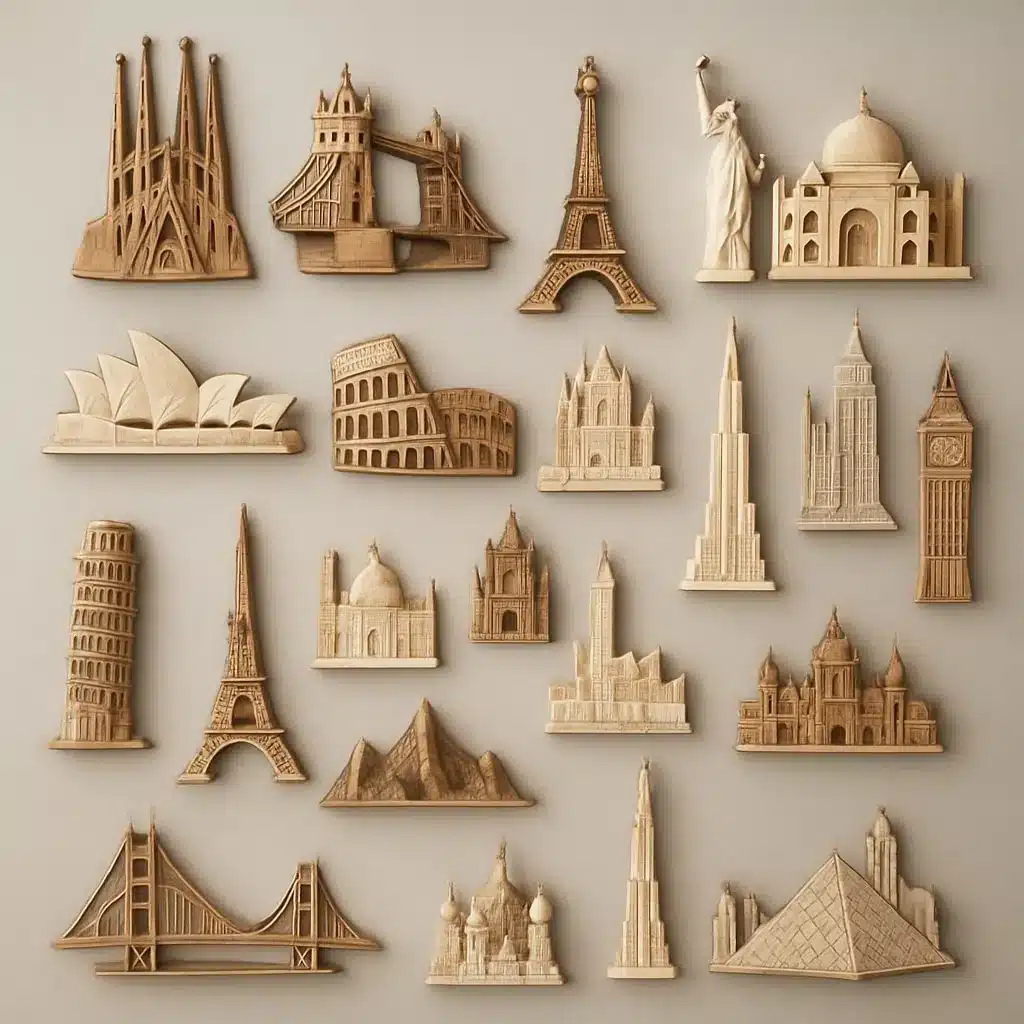
Why these landmarks work for puzzles and models
Choosing the right subject is the first step in a successful architectural puzzle or model project. Good candidates have a clear silhouette, layered details that translate to puzzle pieces or printable parts, and broad cultural recognition so the finished object delights both makers and viewers. Below are 20 buildings and structures that strike that balance—ranked for how well they translate into 2D jigsaw puzzles, laser-cut layered models, and small-scale 3D prints.
For context on how landmarks contribute to a city’s identity—which helps when deciding whether to present a single building or an entire skyline—see recognizable city skylines.
Ranking: Top 20 architectural landmarks for puzzles
- Sagrada Família (Barcelona) — Complex verticality and repeating pinnacles make this basilica perfect for multi-layer laser-cut models and puzzle sections that reveal decorative façades as you assemble.
- Tower Bridge (London) — Distinct towers and the bascule span provide clear, interlocking shapes ideal for 2D silhouette puzzles and small mechanical model kits that mimic the opening span.
- Osaka Castle (Osaka) — Tiered roofs and pronounced eaves create stacked layers that work beautifully in stacked plywood models and interlocking 3D parts.
- Eiffel Tower (Paris) — A lattice structure with a memorable outline; excellent for wireframe-style puzzles, metal kits, and simplified 3D prints emphasizing negative space.
- Statue of Liberty (New York) — A single-figure silhouette with dramatic drapery lines and a recognizable torch—well-suited for tabletop statues, layered jigsaws, and scale models.
- Taj Mahal (Agra) — Symmetry and domes let makers create mirrored puzzle halves or modular 3D dome assemblies that read well even at small scales.
- Sydney Opera House (Sydney) — Its sail-like shells are iconic and translate to bold puzzle pieces or curved laser-cut panels for sculptural models.
- Colosseum (Rome) — Repeating arches and an elliptical plan make a great circular jigsaw or ringed layered model with removable sections to show interior levels.
- Notre-Dame (Paris) — Before-and-after restoration versions both present opportunities: the twin towers and rose window are strong focal points for 2D puzzles and facade-focused models.
- Hagia Sophia (Istanbul) — The massive dome and minarets are visually distinct; layered bases and domes work well in both plywood stacks and 3D printed kits.
- Empire State Building (New York) — Clean vertical profile and tiered setbacks make a striking postcard puzzle or an elegant 3D skyline piece.
- Elizabeth Tower / Big Ben (London) — A tall, narrow silhouette with a clock face—ideal for puzzle cornerpieces, modular clockface inserts, and miniature model kits.
- Leaning Tower of Pisa (Pisa) — The lean is the hook: cylindrical rings and visible tilt are simple to model and satisfy both puzzle solvers and makers looking for characterful builds.
- Burj Khalifa (Dubai) — A striking spire that reads well at scale; a single-piece focal puzzle or stacked-tier 3D model emphasizes verticality without excessive detail.
- Machu Picchu (Peru) — Terraced ruins and stepped platforms lend themselves to layered topographic puzzles and modular terrain models that combine architecture with landscape.
- Angkor Wat (Cambodia) — Central towers and reflective symmetry translate to mirrored puzzle halves and compact 3D kits that highlight silhouette and relief carving.
- Neuschwanstein Castle (Germany) — Fairy-tale turrets and steep roofs are instantly recognizable, making it a favorite for illustrative jigsaws and delicate laser-cut models.
- St. Basil’s Cathedral (Moscow) — Colorful onion domes with varied profiles are a maker’s playground: modular domes, interchangeable patterns, and small decorative puzzle pieces.
- Golden Gate Bridge (San Francisco) — Long-span structure with two towers and suspension cables—excellent for panoramic puzzles and scaled bridge kits that include roadway and piers.
- Louvre Pyramid (Paris) — Minimalist geometry and strong reflections work well in clear acrylic models, negative-space puzzles, and hybrid 2D/3D sets where the pyramid sits before a detailed facade.
How to choose the right format
Once you’ve picked a landmark, decide on the format based on the qualities above:
- 2D jigsaws: Best for bold silhouettes and strong graphic details like windows, arches, and façades.
- Layered laser-cut models: Ideal for buildings with stacked massing or tiered roofs (Osaka Castle, Taj Mahal, Neuschwanstein).
- 3D printing and resin kits: Suited to sculptural details and small figurative elements such as statues and spires.
- Hybrid sets: Combine a 2D skyline backdrop with detachable 3D landmarks for display-friendly collections.
See real-world examples and where to buy
For visual inspiration, check our examples of landmark puzzle projects that show how makers solved scale and detail challenges. If you prefer to purchase finished sets or commission a custom model, our guide on where to buy or commission models lists vendors, custom laser-cutters, and small studios that specialize in landmark work.
Quick tips for makers
- Start with a simplified silhouette study—reduce complex ornamentation to readable shapes before adding detail.
- Design for assembly: add registration tabs or numbered layers for stacked models and provide a clear edge-to-edge puzzle plan for 2D sets.
- Consider materials early: plywood lends warmth and structural rigidity; acrylic offers crisp edges and color transparency; resin enables fine ornamentation.
Final note
These 20 landmarks span styles, eras, and building types, but they share qualities that make them excellent puzzle and model subjects: clarity at small scale, memorable profiles, and opportunities for layered or modular construction. Whether you’re assembling a skyline set, designing a laser-cut souvenir, or choosing a collectible, this list is a practical starting point for translating iconic architecture into tactile, puzzling objects.